
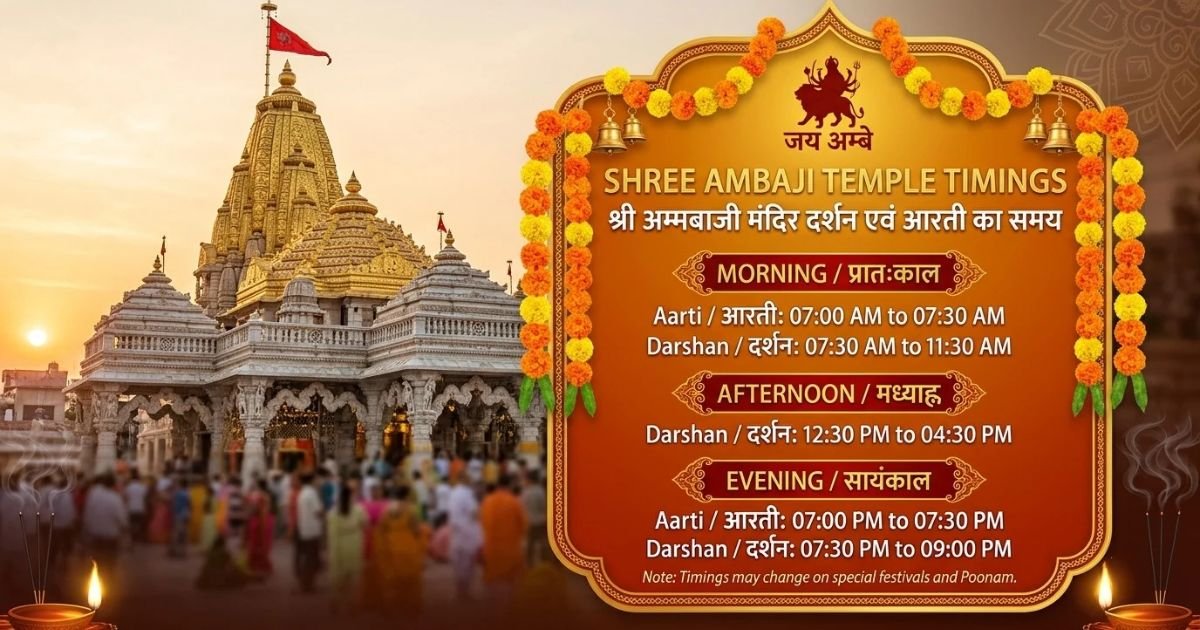

Ambaji Temple in Banaskantha, Gujarat, is one of the 51 Shakti Peethas and one of the most visited Mata temples in India. Pilgrims come from Gujarat, Rajasthan and abroad. Many arrive without knowing that timings change by season, festival and trust decisions.
This guide gives you the current darshan and aarti schedule, ropeway and food details, history, dress rules and travel routes in one place. Timings are based on the temple trust’s published schedule and recent news. Always confirm before a long trip.
Ambaji Temple Darshan Timings 2026
The temple is open every day of the week, and entry for darshan is free. The Shri Arasuri Ambaji Mata Devasthan Trust revised the schedule from 16 July 2026 to improve crowd flow. The biggest change is that darshan now continues in the afternoon.
Current daily schedule:
| Session | Time |
| Morning aarti | 7:30 AM to 8:00 AM (some reports say 7:00 AM to 8:00 AM) |
| Morning darshan | 8:00 AM to 11:30 AM |
| Rajbhog (afternoon offering) | 12:00 noon |
| Afternoon darshan | 12:30 PM to 4:30 PM |
| Evening aarti | 7:00 PM to 7:30 PM |
| Evening darshan | 7:30 PM to 9:00 PM |
Quick answer: Ambaji Temple is open from about 7:30 AM to 9:00 PM, with a short break between 11:30 AM and 12:30 PM and another from 4:30 PM to about 7:00 PM.
Some older sources list darshan from 6:00 AM or 7:00 AM. Those were earlier or seasonal schedules. If you plan to attend the morning aarti, reach the temple by 7:15 AM.
Ambaji Temple Timings Tomorrow
Tomorrow’s timing will normally match the table above. Changes usually happen only on these occasions:
- Bhadarvi Poonam fair days
- Navratri
- Annakut and other special festival days
- Eclipse days (the temple usually closes during the Sutak period)
- Local administrative decisions
For the next day, open the trust’s website (ambajitemple.in). The homepage shows that day’s darshan schedule, usually in English and Gujarati.
Ambaji Temple Open or Closed Today / Tomorrow
The temple does not close for a full day in normal conditions. It is “closed” only during the breaks between sessions. Use this simple check:
- Look at the current time and compare it with the table above.
- Open the trust website for the day’s posted schedule.
- Call the temple office if a festival or eclipse falls on your date.
- Ask your hotel or dharamshala front desk. They usually know first.
Ambaji Temple Opening and Closing Time
The temple opens for aarti around 7:30 AM and closes for the night at 9:00 PM. In festival periods the gates may open earlier and close much later. During Bhadarvi Poonam, the trust has published a schedule with darshan running late into the night.
Seasonal patterns also exist. Summer afternoons can see slightly shorter or shifted sessions because of the heat. Winter evenings may close a little earlier. The 2026 revision aims to keep a steady daily pattern, but the trust can change it with short notice.
Ambaji Aarti Timings: Today’s Schedule
Aarti is the most atmospheric part of a visit. The sanctum fills with bells, conch sounds and devotional chanting.
Daily aarti schedule:
- Morning aarti: around 7:30 AM to 8:00 AM
- Rajbhog: 12:00 noon (darshan is paused for the offering)
- Evening aarti: 7:00 PM to 7:30 PM
Here is what I suggest from experience of how these visits usually go. The evening aarti draws bigger crowds than the morning one. If you want a clear view, join the queue 30 to 40 minutes early. On weekends, allow more time.
Darshan is not allowed in the sanctum during the aarti itself in the usual flow. Pilgrims wait in the queue and enter once darshan starts.
Ambaji Darshan Time Latest News & Navratri Updates
Here are the key updates for 2026:
- Revised schedule from 16 July 2026. The trust introduced afternoon darshan from 12:30 PM to 4:30 PM. Earlier, the temple stayed closed to devotees after Rajbhog.
- Evening gates stay open until 9:00 PM, helping visitors who arrive late from distant places.
- Sharadiya Navratri 2026 began on 11 October. The festival period brought special arrangements and longer hours.
- Bhadarvi Poonam 2026 was celebrated in early September, with the big annual fair.
For the next major event, watch for Chaitra Navratri in spring 2027 and Bhadarvi Poonam in September 2027. The trust usually announces special timings a few days before each festival. Seva camps and registrations for the fair are also listed on the official website.
Related Post: Kateramma Temple Hoskote Kambalipura: Timings, History, Rituals & Sacred Traditions Explained
Ambaji Temple Official Website & Contact Details
The official body is the Shri Arasuri Ambaji Mata Devasthan Trust, based in Ambaji, Banaskantha, Gujarat (PIN 385110).
What the official site offers:
- Daily darshan and aarti schedule
- Online donation
- Prasad ordering (the famous Mohanthal)
- Seva camp registration for fairs
- Temple mobile app with live darshan updates
Safety tip: Use only the official domain, ambajitemple.in, for donations and bookings. Fake booking pages exist for many famous temples. If a site asks for payment through a personal account, close it.
Ambaji Bhojanalaya Timings and Food Details
The trust runs Shree Ambika Bhojanalaya, a clean, low-cost meal facility for devotees.
- Timings: 10:00 AM to 10:00 PM daily
- Full meal: about ₹165 (reported rate)
- Full meal with sweet: about ₹215
- Children up to 10 years: about ₹115 (₹165 with sweet)
The food is simple Gujarati vegetarian thali style. No onion-garlic heavy preparation is typical for temple kitchens, though you should confirm at the counter if that matters to you. Prices can change, so treat these figures as a guide.
Many dharamshalas around the temple also serve home-style meals. Mohanthal prasad from the temple counter is the best take-home item.
Spiritual Significance & History of Ambaji Temple
Ambaji is counted among the 51 Shakti Peethas. According to the Tantra Chudamani tradition, part of Goddess Sati’s heart fell at this site after her body was carried by Lord Shiva. That belief makes Ambaji a heart-center of Shakti worship.
Local tradition also connects the area with several epic stories. It is said that Lord Krishna’s mundan (first hair-cutting) ceremony took place on Gabbar Hill. Another account links Lord Rama and Sita to the hill during the Ramayana period. These are traditional beliefs, and devotees treat them with deep respect.
The present temple is built in the Nagara style and was expanded in phases through the late twentieth century. It is managed by the Devasthan Trust, which handles darshan, donations and facilities.
Two sites matter to a pilgrim:
- Arasuri Ambaji Temple at the foot of the hills, the main temple town
- Gabbar Hill (Gabbar Tirth), about 3 to 4 km away, the original seat of the Goddess
A Temple Without an Idol
This is what surprises first-time visitors. There is no statue of the Goddess inside the sanctum. The object of worship is the Visa Shri Yantra, a sacred geometric diagram inscribed on a plate. It carries 51 Beej (seed) letters connected to the Shakti Peethas.
The Yantra is decorated so beautifully that many visitors assume they are seeing an idol. Traditionally, the priest who performs the puja does so with his eyes covered, and photography of the Yantra is not allowed. Devotees believe the Yantra radiates the Goddess’s power in an abstract form.
At Gabbar Hill, an eternal flame (Akhand Jyot) burns near the footprint marks (pagla) of the Goddess. Many pilgrims treat the Gabbar visit as incomplete without it.
Ambaji Temple Architecture and Layout
The main temple shows classic Nagara-style features: a tall shikhar, a mandap hall and a sanctum. The white marble work gives the complex a calm, bright look. The Suvarna Shikhar (gold-plated spire) is the most striking feature and glows in the evening light.
How the complex flows:
- Entry gate and security check
- Queue hall with barricades and shaded areas
- Mandap (assembly hall)
- Sanctum with the Visa Shri Yantra
- Exit route toward the prasad counter
The hills behind the temple belong to the Aravalli range. Gabbar Hill sits above the town, giving a natural backdrop to the whole pilgrimage.
Dress Code, Darshan Etiquette & Visitor Guidelines
There is no strict dress code, but modest, decent clothing is expected.
Do:
- Wear comfortable, modest clothes that cover shoulders and knees.
- Remove footwear at the designated stands.
- Keep mobile phones silent and stored away near the sanctum.
- Follow the queue and instructions from staff.
- Carry your valuables in a small bag, as crowds can be heavy.
Don’t:
- Click photos inside the sanctum area
- Carry large bags into the queue hall (lockers are available nearby)
- Push in the queue on busy days
Crowd and waiting time: On normal days, the wait is often around 30 to 40 minutes. Fridays, Saturdays, Sundays and festival days can take much longer. The best time for a calm darshan is a weekday morning or mid-afternoon.
Ambaji Ropeway Service at Gabbar Hill
You can reach Gabbar Hill by climbing about 999 steps or by taking the ropeway. The ropeway is operated under the Udan Khatola brand and began service in 1998.
Ropeway details:
- Timings: 7:00 AM to 7:00 PM (as per the operator’s website)
- Ride length: about 636 meters
- Ride time: about 2 minutes
- Cabin capacity: 4 passengers
- Adult ticket: ₹125
- Child ticket: ₹70
- Combined Gujarat ropeway ticket: valid for Girnar, Pavagadh and Ambaji, priced around ₹974 for adults
Tickets can be booked online on the official Udan Khatola website. The helpline is 1800-202-4050. Tickets are generally non-refundable and non-reschedulable, and rides can be paused during strong wind or maintenance. Some years the ropeway shuts for a few days of servicing, so check ahead.
Elderly pilgrims should prefer the ropeway. The steps are manageable for fit visitors but tiring in summer heat.
Festivals Celebrated at Ambaji Temple
Festivals transform the town. Crowds multiply, and many pilgrims walk long distances on foot.
- Bhadarvi Poonam (Bhadrapad full moon): the biggest event. Lakhs of devotees, many on padyatra (walking pilgrimage), reach Ambaji for the fair.
- Sharadiya Navratri (Ashwin): nine nights of garba, aarti and special rituals.
- Chaitra Navratri: a quieter but important spring festival.
- Diwali and Annakut: the town is decorated, and special offerings are made.
- Poshi Poonam and Maha Shivratri: also draw regular devotees.
During these days, expect modified timings, heavy traffic and limited parking. Book rooms at least a few weeks ahead.
Places to Visit Near Ambaji Temple
Add these to your trip for a fuller itinerary:
- Gabbar Hill: the original shrine and sunset viewpoint
- Kumbhariya Jain Temples: a group of finely carved marble Jain temples, about 1.5 to 2 km away
- Kamakshi Temple: about 3 km away
- Koteshwar Mahadev: an ancient Shiva temple near the Saraswati river source, around 5 to 6 km away
- Mansarovar Kund: a sacred pond close to the temple
- Kailash Tekri: a hilltop sunset point
- Mount Abu, Rajasthan: a hill station about 45 km away
- Taranga Jain Tirth: about 50 km away
If you have only a day, combine the temple, Gabbar Hill and Kumbhariya.
Ambaji Temple Distance from Major Cities
Approximate road distances:
| City | Distance |
| Abu Road | 20 km |
| Mount Abu | 45 km |
| Palanpur | 60 km |
| Gandhinagar | 160 km |
| Ahmedabad | 175 km |
| Udaipur | 170 km |
| Surat | about 480 km |
| Mumbai | about 750 km |
Distances vary slightly by route. Plan extra time for hilly roads near Abu.
How to Reach Ambaji Temple
By road: The easiest option. From Ahmedabad, take the highway toward Palanpur and then Ambaji. The drive takes roughly 3.5 to 4 hours. State buses and private taxis run regularly. During festivals, traffic diversions are common.
By train: The nearest major station is Abu Road (about 20 km), with good connections to Ahmedabad, Delhi, Mumbai and Jaipur. Palanpur is another useful junction. From either, take a taxi or bus to Ambaji.
By air: The nearest major airport is Sardar Vallabhbhai Patel International Airport, Ahmedabad (about 184 km). Udaipur’s Maharana Pratap Airport is another option for travellers from Rajasthan.
Local travel: Auto-rickshaws and shared jeeps connect the temple, bus stand and Gabbar Hill.
Accommodation Options Near Ambaji Temple
The town offers a wide budget range, from simple dharamshalas to private hotels.
- Dharamshalas and pathikashrams: the most affordable. Rooms start around ₹350 to ₹450 in several listings. Many sit within 200 to 900 meters of the temple.
- Budget hotels: AC and non-AC rooms near the bus stand.
- Mid-range hotels: better for families who want comfort and parking.
- Trust-run facilities: simple and trustworthy, though they fill up fast.
Booking tips:
- Book well ahead for Navratri and Bhadarvi Poonam.
- Choose a place within walking distance to avoid vehicle hassle.
- Confirm check-in and check-out times and the cancellation rules.
- Ask whether the stay includes meals or parking.
Frequently Asked Questions
What are the Ambaji Temple darshan timings?
Darshan runs from 8:00 AM to 11:30 AM, 12:30 PM to 4:30 PM and 7:30 PM to 9:00 PM. Aarti takes place in the morning and from 7:00 PM to 7:30 PM.
What time does Ambaji Temple open and close?
It opens around 7:30 AM with the morning aarti and closes at 9:00 PM. Festival days can run longer.
Is Ambaji Temple open today?
Yes, it is open every day, subject to the session breaks. Check the official website for festival or eclipse changes.
What is the Ambaji morning aarti time?
It is about 7:30 AM to 8:00 AM, though some reports list 7:00 AM to 8:00 AM. Reach early to be safe.
Is there an idol in Ambaji Temple?
No. The Goddess is worshipped in the form of the Visa Shri Yantra.
Is entry to Ambaji Temple free?
Yes, darshan is free for all devotees.
Is photography allowed inside Ambaji Temple?
Photography is not allowed in the sanctum area. Follow the staff’s instructions elsewhere.
What is the Ambaji ropeway ticket price?
An adult ticket costs ₹125 and a child ticket ₹70, per the operator’s published rates.
What are the Ambaji ropeway timings?
The ropeway runs from 7:00 AM to 7:00 PM, subject to weather and maintenance.
How many steps lead to Gabbar Hill?
About 999 steps.
What are Ambaji Bhojanalaya timings?
It serves food from 10:00 AM to 10:00 PM every day.
How far is Ambaji from Ahmedabad?
Around 175 km, a drive of roughly 3.5 to 4 hours.
Which is the nearest railway station to Ambaji?
Abu Road, about 20 km away.
Which is the best time to visit Ambaji?
October to March has pleasant weather. For fewer crowds, choose a weekday.
What is the dress code at Ambaji Temple?
No strict code exists, but modest, decent clothing is expected.
Conclusion
Ambaji Temple is more than a famous Shakti Peetha. It is a place where simple worship of the Visa Shri Yantra, the hill setting and a strong pilgrimage tradition come together. Knowing the 2026 timings, the ropeway rules and the best hours to visit makes your trip smoother.
Plan around the morning or evening aarti, travel on a weekday if you can, and always confirm the day’s schedule on the official website before you leave. Do that, and your darshan is likely to be peaceful and well organized.

Wei Zhang is the admin of Magazinereflex.com, a travel-focused website dedicated to exploring destinations, sharing travel tips, and inspiring memorable adventures. With a passion for discovering new places and learning about different cultures, Wei Zhang aims to provide readers with helpful travel guides, destination insights, and practical advice to make their journeys more enjoyable. His goal is to inspire travelers to explore the world with confidence and curiosity.
