
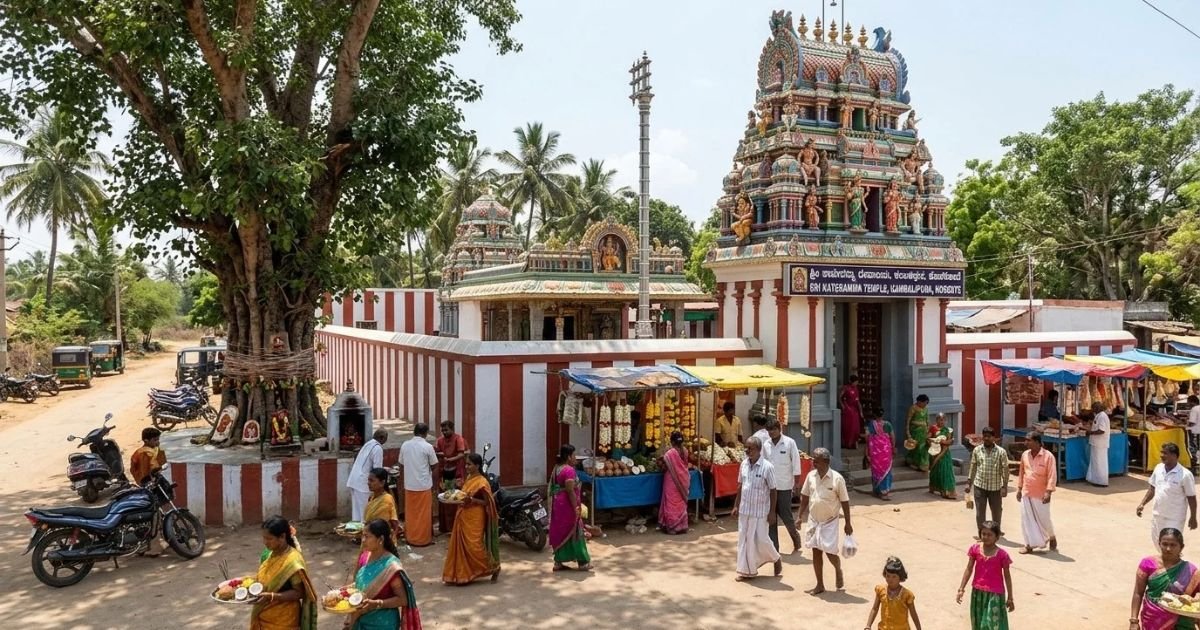

Kateramma Temple Hoskote Kambalipura is a quiet village goddess shrine near Hoskote in Bengaluru Rural, about 35 to 40 km from central Bengaluru. Devotees come here to pray for protection, family harmony, health, marriage and children, drawn by the folk legend of Kateri, a devout woman now worshipped as Goddess Kateramma.
This guide covers commonly listed darshan timings, the temple’s history, daily rituals, Friday poojas, festivals, how to perform a vow and how to reach the temple. It also points out where online details disagree, so you can plan your visit with confidence and avoid arriving at the wrong Kateramma temple.
Who Is Goddess Kateramma? The Legend Behind the Deity
Kateramma is worshipped as a protective village goddess. Devotees believe she was once a woman named Kateri who lived in this region many generations ago.
This story is not found in classical scripture. It is folklore, carried forward by families and elders. That is normal for Gramadevata traditions in South India, where local memory matters more than written texts.
According to the legend, Kateri was kind and deeply devoted to the Divine Mother. She prayed every day. But she had no children, and the social attitudes of her time were harsh. She was mocked and pushed to the edge of village life.
Unable to bear it, she walked into the forest nearby and never came back.
The Discovery of the Sacred Idol
Years later, a shepherd grazing his cattle noticed a soft glow beneath a large tree. When he went closer, he found a carved idol of a goddess.
The news travelled quickly. Villagers gathered and came to believe the idol was Kateri herself. In their eyes, the woman who had been rejected had become a divine guardian. From that point, worship of Goddess Kateramma began.
Please note that no inscription or official record confirms this account. It is a living tradition, and it is best read that way. One online directory mentions that the temple is believed to be around 300 years old, but this is a local belief and I could not find a documented source for it.
Goddess Kateramma → Protects → Devotees From Hardships
The core belief at this temple is simple. Goddess Kateramma protects those who come to her with sincere faith.
Scholars describe a Gramadevata as the tutelary deity of a locality. In South India this deity is usually a goddess who guards the village, watches over fertility and is believed to keep disease and disaster away. Kateramma fits that role closely.
Devotees visit with many kinds of prayers:
- Peace and harmony at home
- A suitable marriage match
- Blessings for a child
- Recovery from illness
- Financial stability during hard phases
- Protection from accidents, disputes and bad luck
- Courage during a difficult period
Locals often share stories of vows that were fulfilled. These accounts are personal experiences and cannot be tested, but they explain why the temple’s reputation keeps growing by word of mouth.
Kateramma Temple Kambalipura Timings: Full Schedule
Timings are the most searched detail, and also the least consistent online. Small village temples rarely publish a fixed schedule, so different websites show different hours.
Here is what is commonly published for the Kambalipura temple:
| Day or occasion | Commonly listed hours |
| Weekdays, including Thursday | 6:30 AM to 7:30 PM |
| Weekends, including Saturday | 6:00 AM to 8:00 PM |
| Festivals and Navaratri | 6:00 AM, closing time extended |
Other listings disagree. One directory shows Tuesday from 5:00 AM to 8:00 PM and Thursday and Saturday from 6:00 AM to 6:00 PM. A map listing shows the temple as open round the clock. Some listings for other Kateramma temples around Hoskote show a break between 1:00 PM and 2:00 PM.
The practical takeaway: plan to arrive between 6:30 AM and 5:30 PM, and call a local contact if you are travelling a long way.
Kateramma Temple Hoskote Weekday Timings (Including Thursday)
On regular weekdays, darshan is commonly listed from 6:30 AM to 7:30 PM. Thursday normally follows this pattern, although one directory lists an earlier evening close.
Kateramma Temple Hoskote Saturday Timings and Weekend Hours
Saturdays and Sundays usually run from about 6:00 AM to 8:00 PM. Footfall is higher, so queues build up by mid-morning.
Kateramma Temple Hoskote Closing Time: Quick Answer
The closing time is commonly listed as 8:00 PM, with weekday darshan ending around 7:30 PM. During the annual jatre and Navaratri, the temple often stays open later.
Reach by 6:30 PM if you want to see the evening aarati without rushing.
Related Post:Tirumala Darshan 2026: Booking, Tickets, Timings & Complete Guide
How Far Is Kateramma Temple Kambalipura? Distance & Directions
The temple is about 35 to 40 km from central Bengaluru. The drive usually takes 1 to 1.5 hours, depending on traffic and your starting point.
Hoskote town itself is close to Bengaluru and well served by BMTC and KSRTC buses. From the town you can reach Kambalipura by cab, auto or your own vehicle.
A small warning about names. Several temples near Hoskote carry the Kateramma name. You will find listings near Halappanahalli, in Hoskote town, and in places such as Pattanduru Agrahara. Always search for “Kateramma Temple Kambalipura” on your map app and check the pin before you leave.
By Road
Road is the easiest option. You can use:
- A private car or two-wheeler
- A cab or app-based taxi
- A BMTC or KSRTC bus to Hoskote, then an auto or cab
- A shared auto from Hoskote town
Some drivers approach through Kallahalli, a nearby village. If your map suggests that route, it is a normal road and not a wrong turn.
By Train
K R Puram Railway Station is the commonly used railhead. From there, take a cab or local transport towards Hoskote and Kambalipura.
By Air
Kempegowda International Airport is the nearest airport and is on the same side of Bengaluru as Hoskote. A cab from the airport to Hoskote town is a short ride compared with crossing the city, and Kambalipura is a little further on.
Daily Rituals and Poojas at Kateramma Temple
The daily routine follows the style of most village temples in Karnataka. It is simple, devotional and shaped by local custom rather than elaborate Agama rules.
Morning Rituals
The day begins early with prayers meant to wake the goddess:
- Suprabhata Seva at dawn
- Cleaning of the sanctum before devotees enter
- Lighting of oil lamps
- Chanting and morning prayers
- Offering of flowers and turmeric to the idol
A morning aarati follows. Many devotees choose this time because the atmosphere feels calm and focused.
Afternoon Offerings
Midday is when the naivedyam, or food offering, is presented. Devotees bring coconuts and lemons, and families conduct small prayers.
This is also a common time for people to fulfil personal vows.
Evening Aarati
If you can attend only one ritual, make it the evening aarati. It includes:
- Deepa Aarati with lamps
- Bhajans sung by gathered devotees
- Bells and drums that build the mood
- Group prayers
The lit temple compound at dusk is calm and lively at the same time. It is the part of the day most visitors remember.
Fridays and Special Poojas: Why the Day Matters
Fridays are considered highly auspicious for Goddess Kateramma, as they are for many Amman and village goddess shrines across South India. Tuesdays are also widely observed at goddess temples in the region, so you may notice a few extra devotees then too.
Women devotees often visit on Fridays and bring:
- Turmeric and kumkum
- Fresh flowers
- Sarees for the goddess
- Bangles
- Coconuts and lemons
If your dates are flexible, a Friday visit gives you a more festive darshan. Expect a moderate crowd, and reach early.
Major Festivals Celebrated at the Temple
Annual Temple Jatre
The jatre is the biggest event of the year. Village jatres in Karnataka are community festivals, and the whole village joins in.
Visitors describe:
- Multi-day poojas
- Processions through the village streets
- Folk music and dance
- Community meals open to all
- A heavily decorated temple compound
Devotees arrive from nearby villages and from Bengaluru. If you want a quiet darshan, avoid these days. If you want the full cultural experience, this is the time to go.
The exact dates are decided locally each year, so confirm with villagers or temple volunteers before planning.
Navaratri Celebrations
Navaratri runs for nine days and features daily poojas, decorations and cultural programmes. It is a good choice if you enjoy festive crowds and community singing more than silence.
Filling the Gap: How to Perform a Vow (Manata) at Kateramma Temple
Most online guides mention vows in a single line and move on. Here is how devotees usually approach one.
A manata is a personal promise to the deity. You ask for something specific, such as a job, a recovery, a child or a marriage proposal, and promise an offering once it is fulfilled. Devotees see it as an act of trust more than a trade.
Typical steps:
- State your request. Stand before the sanctum and say it silently or aloud.
- Decide on your offering. Common choices are a saree, coconuts, a turmeric and kumkum set, or sponsoring a small pooja.
- Return when the wish is fulfilled. There is no strict deadline, but most people try to return within the time they had in mind.
- Offer the promised item. Bring it during a regular darshan, or during the jatre for larger vows.
- Join a thanksgiving pooja. The priests can guide you, usually for a small donation.
Nothing needs to be expensive. Devotees say sincerity counts for more than the cost of the offering. Ask the priest about customs before you begin, because practices can differ between families.
Kateramma and Other Village Goddesses of Karnataka: A Regional Connection
Kateramma belongs to a wide tradition of Gramadevata worship. Across Karnataka, Tamil Nadu and Andhra Pradesh, village goddesses such as Mariamma, Yellamma and Bannari Amman protect their communities.
Many of their stories share a pattern. A woman faces injustice or hardship, and later she is revered as a fierce, protective deity. Sometimes the story involves a miraculous idol that is found in a forest or under a tree, just as in Kateramma’s legend.
Spiritual Importance of Kateramma Temple
For the local community, the temple stands for several things:
- Faith in divine motherhood, even outside conventional norms
- Preservation of rural Karnataka traditions
- A shared sense of community, most visible during the jatre
- Folk spirituality that grows alongside mainstream temple worship
- Continuity of village customs as the Bengaluru suburbs expand
Best Time to Visit Kateramma Temple
- Weekday mornings: The quietest and best for a peaceful darshan
- Fridays: Spiritually significant, with a moderate crowd
- Amavasya days: Meaningful for many devotees, usually moderately busy
- Navaratri: Festive and colourful
- Annual jatre: Best for culture, worst for calm
- Winter months: The most comfortable weather for travel
Travel Tips for Devotees Visiting the Temple
- Dress modestly. This is a working village temple, not a tourist spot.
- Carry water. Shaded rest areas are limited.
- Go early. Mornings are calmer, and weekend queues are shorter before 9:00 AM.
- Verify the temple pin. Several nearby temples share the Kateramma name.
- Confirm timings by phone or with locals. Hours change around festivals.
- Follow local customs. Remove footwear where asked and keep voices low near the sanctum.
Conclusion
Kateramma Temple in Kambalipura is a modest shrine with a strong hold on its community. It has no grand architecture or written scripture to point to. What it has is a story, generations of faith and a daily rhythm of prayer that visitors find genuinely moving.
For planning, remember three points. Arrive between 6:30 AM and 5:30 PM, since timings differ between sources. Check that your map pin says Kambalipura. And choose your day to match the experience you want: a weekday for quiet, a Friday for devotion, the jatre or Navaratri for celebration.
FAQ’s
What is the history of the Kateramma Temple in Hoskote?
The temple’s history is oral tradition, not written record. Locals say a shepherd found a glowing idol under a tree and villagers took it to be Kateri, a devout woman who left the village and became Goddess Kateramma. No inscription confirms this, and one directory’s claim that the temple is about 300 years old is only a local belief.
Which day is good to visit Kateramma Temple in Hoskote?
Friday is considered the most auspicious day, especially for women offering turmeric, kumkum and sarees. For a quieter darshan, choose a weekday morning, and for festive crowds, visit during Navaratri or the annual jatre.
Who is Kateramma Devi?
Kateramma Devi is a Gramadevata, or village guardian goddess, worshipped across the Hoskote area. Devotees believe she is the divine form of Kateri and pray to her for protection, health, marriage, children and family harmony.
What are the timings for the Kateramma Temple in Hoskote, Kambalipura?
Commonly listed hours are 6:00 AM to 8:00 PM, with weekday darshan from about 6:30 AM to 7:30 PM. Listings differ and festival days run later, so arrive before 5:30 PM or confirm locally.
How do I go to Kateramma Temple Hoskote from my location?
Search “Kateramma Temple Kambalipura” in your map app and confirm the pin before you start, since other Kateramma temples are nearby. From Bengaluru it is about 35 to 40 km, or 1 to 1.5 hours by road, via Hoskote town.
Where is the Kateramma Temple located?
It is in Kambalipura village near Hoskote town, Bengaluru Rural district, Karnataka. The temple is roughly 35 to 40 km from central Bengaluru.

Wei Zhang is the admin of Magazinereflex.com, a travel-focused website dedicated to exploring destinations, sharing travel tips, and inspiring memorable adventures. With a passion for discovering new places and learning about different cultures, Wei Zhang aims to provide readers with helpful travel guides, destination insights, and practical advice to make their journeys more enjoyable. His goal is to inspire travelers to explore the world with confidence and curiosity.
