
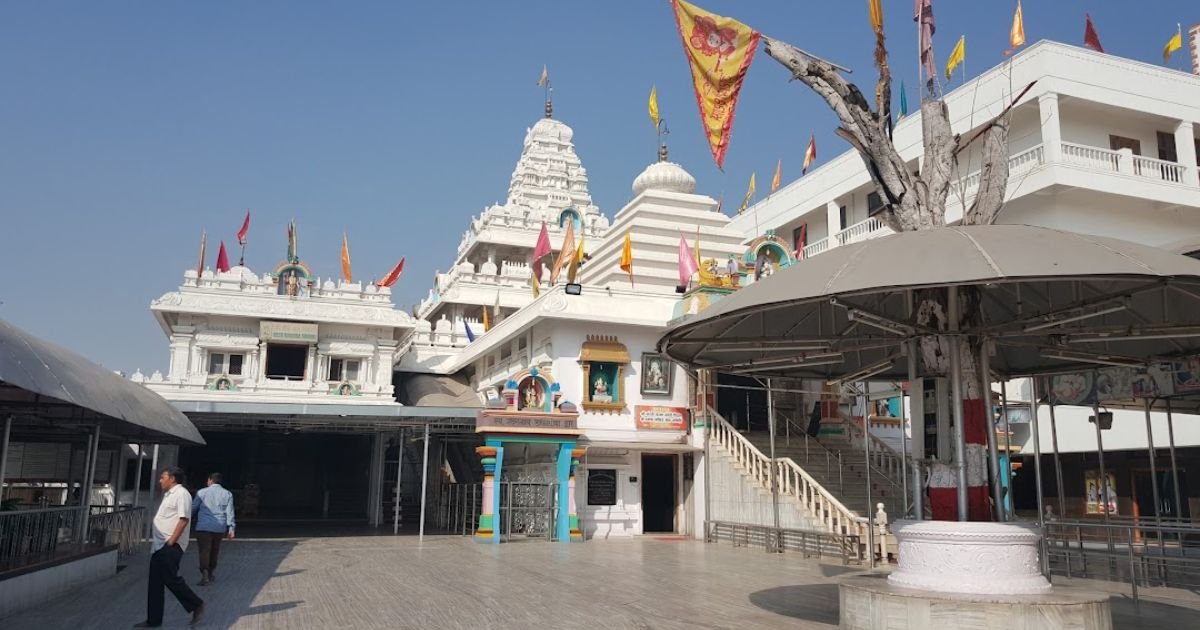

Shyam Mandir Kachiguda is a Khatu Shyam temple in Hyderabad, Telangana, built by the Shree Shyam Mandir Seva Samithi and opened in 1996. It stands on Veeranna Gutta, opposite Kachiguda Railway Station. Devotees come for Shyam Baba, but they stay for the seven shrines, the bhajans, and the festival crowds.
This guide covers the temple’s history, the legend behind the deity, each sub temple, daily rituals, festivals, timings, and travel routes. You’ll also find quick answers at the end.
Shyam Mandir Kachiguda at a Glance
| Detail | Information |
| Main deity | Khatu Shyam Baba (Barbarika) |
| Location | Veeranna Gutta, Kachiguda Station Road, Hyderabad 500027 |
| Opened | 22 April 1996 |
| Managed by | Shree Shyam Mandir Seva Samithi |
| Usual timings | 6:00 AM to 12:00 PM and 5:00 PM to 10:00 PM |
| Entry fee | Free |
| Nearest railway station | Kachiguda Railway Station |
| Best days | Ekadashi, Janmashtami, Falgun Mela |
Historical Background of Shyam Mandir Kachiguda Hyderabad
This temple began with a group of families. In 1992, a circle of North Indian devotees in Hyderabad formed the Shree Shyam Mandir Seva Samithi. They wanted a Khatu Shyam temple close to home, so they set out to build one.
The committee chose temple architect Sri Ganapathi Satpati for the design. Sri Jayendra Saraswathi Swamy of Kanchipuram reviewed the plan. The Bhoomi Pooja followed on 5 May 1994, with Sri Raghunathmalji Goel presiding.
Construction took about two years. Then on 22 April 1996, Sri Jayendra Saraswathi Swamy and Sri Ananth Saraswathi Swamy inaugurated the temple. A large bhajan evening capped the day, with singers Nandu Bhaiya and Shyam Sunderji Sharma performing for the crowd.
Here’s a quick timeline:
- 1992: Devotees form the Seva Samithi.
- 5 May 1994: Bhoomi Pooja takes place.
- 22 April 1996: The temple opens to the public.
Some older directory listings show different years, so treat 1996 as the inauguration date. It appears most often and matches the temple’s own story.
Mythological Significance of Shyam Baba
Shyam Baba’s story comes straight from the Mahabharata. To understand why thousands queue here, you need to know who he was before he became a deity.
The Story of Barbarika
Barbarika was a young warrior of the Dwapara Yuga. His father was Ghatotkacha, and his grandfather was Bhima. He worshipped the Goddess and won three powerful arrows as a blessing.
Just before the Kurukshetra war, he set out to watch it. He had also promised his mother that he’d back whichever side was losing. Krishna saw the problem. That promise would keep flipping the war’s outcome.
Krishna met him disguised as a Brahmin and asked for a gift. Barbarika agreed, and the Brahmin asked for his head. Barbarika gave it without a fight. Krishna then revealed himself and made a promise: in the Kali Yuga, people would worship Barbarika by Krishna’s own name, Shyam.
Think of it as the ultimate lesson in giving. That’s why devotees call him “Haare Ka Sahara,” the support of the one who has lost.
The Discovery of Khatu Shyam
According to tradition, Barbarika’s head was found in the village of Khatu in Rajasthan’s Sikar district. Devotees say King Roopsingh Chauhan built the first shrine there in 1027 AD. The Khatu Shyam Temple grew into one of North India’s best known pilgrimage centres.
Kachiguda carries that tradition south. For families who moved from Rajasthan and nearby states, this temple offers a piece of home.
Architecture of Shyam Mandir Complex
The temple mixes North Indian devotion with South Indian craftsmanship. You’ll spot a tall gopuram with carved figures, while the interior feels open and practical.
Key Architectural Features
- Size: About 30,000 square feet across three floors.
- Lift: Elderly and differently abled visitors can use it.
- Gopuram: Sculpted panels show classical Hindu motifs.
- Halls: Two large mandapam style halls hold hundreds of people.
- Bhajan stage: A dedicated stage hosts evening singing.
- Facilities: A kitchen hall and a food court support festival crowds.
- Sanctum: The garbhagriha is well lit, so the main idol is clearly visible.
The design avoids showiness. It feels grand without overwhelming you, which suits a place people visit daily.
Main Deity: Shyam Baba
The main idol of Khatu Shyam Baba sits at the heart of the complex. Everything else, from the aarti schedule to festival planning, revolves around him.
Priests dress the idol in fresh clothes (Poshak) every day. The colour and style change with the weekday and the festival calendar. On big occasions, the idol gets heavy flower decorations plus gold and silver ornaments.
Devotees pray to Shyam Baba for relief in hard times, whether it’s a stalled job, a family worry, or a health scare. Many say they come simply because the darshan calms them. Regulars often plan their week around Ekadashi visits.
Sub Temples Inside Shyam Mandir Complex
Shyam Mandir Kachiguda houses six sub temple groups, covering seven deities in all. That variety makes the complex a true one-stop darshan.
1. Radha Krishna Temple
This shrine celebrates divine love. Devotees sing bhajans here every day. It gets especially busy on Janmashtami and Radhastami.
2. Lakshmi Narayana Temple
People visit this shrine to pray for prosperity, family harmony, and peace of mind. It’s a favourite for new business owners and newlyweds.
3. Lord Anjaneya Shrine
The Anjaneya shrine is small, but crowds gather on Tuesdays and Saturdays. Devotees seek courage, good health, and protection here.
4. Kaal Bhairava Shrine
Kaal Bhairava is a fierce form of Lord Shiva. Worshippers pray to him to remove obstacles and shield the family from harm.
5. Shiva Temple
The Shiva temple holds a lingam. Priests perform abhishekam on Mondays and grand rituals on Mahashivratri.
6. Amba Mata and Naag Devta Shrines
The last group honours Amba Mata and Naag Devta. These shrines let visitors from different traditions pray under one roof.
Visiting tip: Start with Shyam Baba, then move clockwise through the sub temples. Most devotees follow this order.
Daily Rituals and Spiritual Activities
The temple runs on a fixed daily rhythm. Priests follow the same order most days, though festival schedules can stretch it.
Morning Session
- Mangala Aarti: The day begins with an early aarti.
- Abhishekam: Priests bathe the idol with milk, honey, and sacred water.
- Offerings: Fresh flowers and seasonal fruit go to the deity.
- Poshak Seva: The idol receives its new attire.
- Bhog: Priests present the day’s food offering.
Evening Session
- Sandhya Aarti: Sunset brings the main evening aarti.
- Bhajan and kirtan: Anyone can join the singing.
- Shej Aarti: This closing ritual ends the day before the temple shuts.
Special Weekly Observances
- Ekadashi and Dwadashi: Devotees see these days as especially auspicious, and the temple extends its rituals.
- Mondays: Shiva devotees fill the Shiva shrine.
- Wednesdays and Saturdays: Crowds grow at the Anjaneya shrine.
- Sevas: You can sponsor a Poshak Seva, Bhog Seva, or Aarti Seva through the temple trust.
If you want to sponsor a seva, ask at the temple office first. Rules and rates can change.
Festivals Celebrated
Festivals turn this quiet hillock into a bustling fair. Expect long queues, bright lights, and a lot of music.
Janmashtami
Janmashtami is the temple’s biggest celebration. Volunteers cover the complex in flowers, lights, and rangoli. Special pujas and midnight celebrations follow, along with bhajan concerts that run late.
Falgun Mela (Khatu Shyam Mela)
The Falgun Mela falls in the Hindu month of Falgun, usually February to March. It’s the festival closest to Shyam Baba’s heart, and it echoes the famous fair at the original Khatu temple.
Hyderabad devotees also hold a Nishan Yatra around Falgun Ekadashi and Dwadashi. Participants carry flags in a procession from the Kachiguda temple, and reports place the route’s end at Malakpet. Route details can change, so confirm them with the Seva Samithi.
Ekadashi Celebrations
Every Shukla Ekadashi brings extra crowds and longer bhajan sessions. Devotees also treat Kartik Shukla Ekadashi as Shyam Baba Jayanti, the deity’s birth anniversary. Plan for a full evening if you visit then.
Other Festivals Observed
- Diwali: Lamps and special pujas fill the temple.
- Holi: Devotees celebrate with colours and singing.
- Radhastami: The temple honours Radha’s birth.
- Govardhan Puja: Volunteers organise it with real enthusiasm.
- Mahashivratri: The Shiva shrine hosts special rituals.
Spiritual Experience at the Temple
Step through the gate, and the traffic outside starts to fade. Bells ring, incense drifts past, and the bhajans build a steady, warm rhythm.
Many visitors say a short stay leaves them lighter. Others enjoy meeting people from Rajasthan, Gujarat, and beyond, all in one hall. The Seva Samithi also runs charity programmes and distributes prasad, so you’ll often see volunteers helping visitors.
A few simple habits make the visit smoother:
- Dress modestly and remove footwear before you enter.
- Carry small change for offerings.
- Keep phones on silent inside the sanctum.
- Follow the volunteers’ queue instructions on busy days.
Shyam Mandir Kachiguda Timings
The temple opens every day, including public holidays. Here are the timings most listings show:
| Session | Timings |
| Morning | 6:00 AM to 12:00 PM |
| Evening | 5:00 PM to 10:00 PM |
Timing notes:
- Entry is free.
- Plan for about one to one and a half hours.
- Early mornings and Ekadashi evenings suit devotional visits best.
- Some online listings show the evening closing at 8:00 PM or 8:30 PM. Call the temple before a late visit.
- Festival days often bring extended hours.
How to Reach Shyam Mandir
Address: Door No. 3-4-1079, Kachiguda Station Road, Veeranna Gutta, Barkatpura, Kachiguda, Hyderabad, Telangana 500027.
By Train
Kachiguda Railway Station sits right opposite the temple. Most visitors walk over in five to seven minutes. Long distance trains from North India stop here, which explains why many pilgrims arrive straight from the platform.
By Road (Bus)
TSRTC buses serve Kachiguda from across the city. The Kachiguda bus stop is a short walk from the temple. Autos and app based cabs are easy to find nearby.
By Metro
The Hyderabad Metro’s Green Line is the practical choice. Listings name both Chikkadpally and Narayanguda as nearby stations. From either one, an auto ride is the easiest way to finish the trip. Check the current route on the Hyderabad Metro Rail site before you travel.
By Air
Rajiv Gandhi International Airport in Shamshabad lies roughly 28 to 29 km away. Prepaid taxis and app cabs run from the terminal. Expect a longer ride during peak traffic hours.
By Personal Vehicle
Parking near the temple is limited. Arrive early on weekdays, and on festival days consider a cab or auto instead.
Why You Should Visit Shyam Mandir Kachiguda?
Here’s why this temple deserves a place on your Hyderabad list:
- Many shrines, one visit: You can pray to Shyam Baba, Radha Krishna, Lakshmi Narayana, Hanuman, Shiva, and more.
- A North Indian tradition in South India: Rajasthani devotional culture meets Hyderabad’s spiritual scene.
- A welcoming atmosphere: Bhajans, flowers, and aarti create a calm setting.
- Easy access: The railway station is directly opposite.
- Free entry: No ticket stands between you and darshan.
- Community service: The temple trust runs charity and food programmes.
- Festival energy: Janmashtami and Falgun Mela are worth seeing at least once.
Shyam Mandir Kachiguda Contact Number
You can reach the temple office at 040-27568479. Other websites list different mobile numbers, so verify the number before you plan a seva booking or a festival visit.
- Office: Shree Shyam Mandir Seva Samithi
- Address: Door No. 3-4-1079, Opposite Kachiguda Railway Station, Kachiguda, Hyderabad 500027
- Website: www.srishyammandir.com
FAQ’s
What is Shyam Mandir Kachiguda famous for?
It’s a well known Khatu Shyam temple in South India, and it blends North Indian devotion with Hyderabad’s spiritual culture.
What are the timings of Shyam Mandir Kachiguda?
The temple usually opens from 6:00 AM to 12:00 PM and 5:00 PM to 10:00 PM daily. Call ahead to confirm the evening closing time.
Is there any entry fee for Shyam Mandir Kachiguda?
No. Entry is free for everyone.
Who founded Shyam Mandir Kachiguda?
The Shree Shyam Mandir Seva Samithi founded it in 1992. Sri Jayendra Saraswathi Swamy and Sri Ananth Saraswathi Swamy inaugurated it on 22 April 1996.
Which is the nearest railway station to Shyam Mandir Kachiguda?
Kachiguda Railway Station is the nearest, directly opposite the temple and a short walk away.
What is the best day to visit Shyam Mandir Kachiguda?
Ekadashi is the most auspicious day, and Janmashtami and Falgun Mela offer the liveliest festival experience.
What is the contact number of Shyam Mandir Kachiguda?
You can call the temple office at 040-27568479. Confirm it before a booking, because listings vary.
How many sub temples are inside Shyam Mandir Kachiguda?
There are six sub temple groups housing seven deities: Radha Krishna, Lakshmi Narayana, Anjaneya, Kaal Bhairava, Shiva, Amba Mata, and Naag Devta.
Conclusion
Shyam Mandir Kachiguda gives you more than a single darshan. You get a legend rooted in the Mahabharata, six sub temple groups, and a community that keeps the bhajans going year round. It’s also easy to reach, since the railway station sits right across the road.
Plan your visit for an Ekadashi evening or an early morning if you want a calm experience. Come during Janmashtami or Falgun Mela if you’d rather see the temple at full volume. Either way, check the timings with the temple office before you go.

Wei Zhang is the admin of Magazinereflex.com, a travel-focused website dedicated to exploring destinations, sharing travel tips, and inspiring memorable adventures. With a passion for discovering new places and learning about different cultures, Wei Zhang aims to provide readers with helpful travel guides, destination insights, and practical advice to make their journeys more enjoyable. His goal is to inspire travelers to explore the world with confidence and curiosity.
