
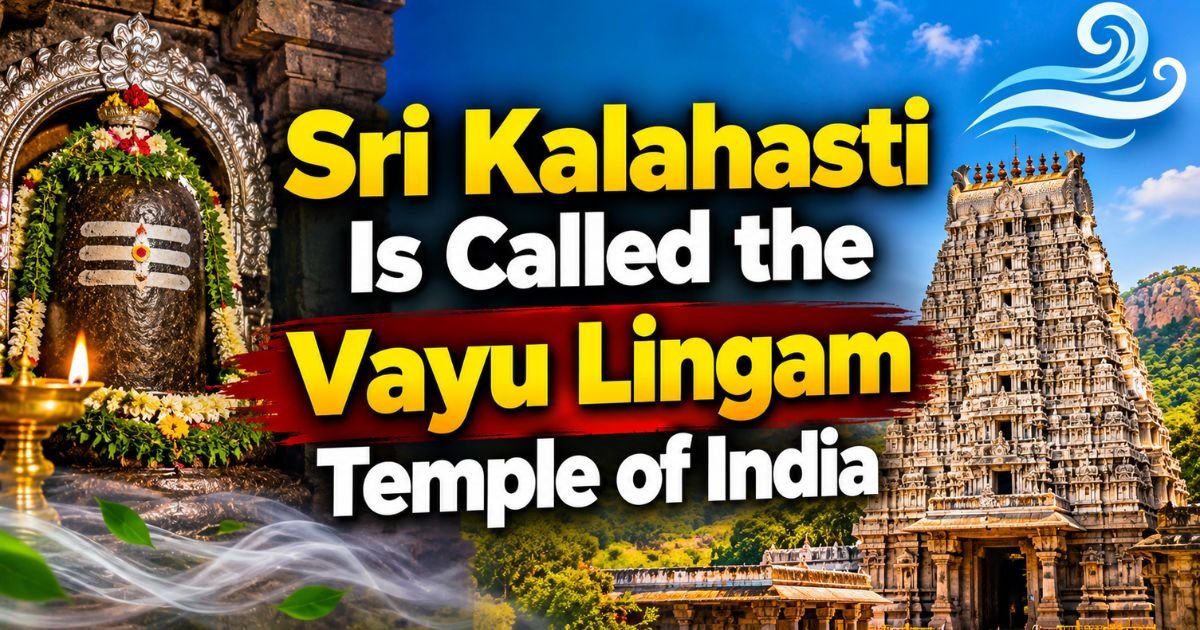

Sri Kalahasti is called the Vayu Lingam temple because its presiding Shiva lingam represents the wind element, one of the five elements honored in the Pancha Bhoota Sthalams.
Located in Andhra Pradesh near Tirupati, the temple is known for a lamp in the sanctum whose flame keeps flickering even though the inner chamber has no visible opening for air.
Why Sri Kalahasti Is Called the Vayu Lingam Temple of India (Divine Secret Explained)

The title comes from two things: an ancient story and a living mystery.
The story says Vayu, the god of wind, worshipped Shiva here for ages. The mystery is the sanctum flame that never stays still. Devotees see it as proof that Vayu is present in the sanctum. Together, these make Sri Kalahasti the wind temple of India.
Quick Facts – The Vayu Lingam of Sri Kalahasti
- Deity: Lord Shiva as Sri Kalahasteeswara
- Consort: Goddess Gnanaprasunambika
- Element represented: Vayu (air or wind)
- Location: Sri Kalahasti, near Tirupati, Andhra Pradesh
- Distance from Tirupati: About 36 km
- River: Suvarnamukhi flows beside the temple
- Early builders: The Pallavas, with later additions by the Cholas and Vijayanagara rulers
- Famous for: The flickering flame, Rahu Ketu pooja, and Mahashivratri celebrations
- Linked saint: Kannappa Nayanar, one of the 63 Nayanars
The Breath of Shiva
Think about how you notice air. You cannot see it, but you feel it move. Sri Kalahasti turns this idea into worship. Here, Shiva is not shown through grand form alone. He is felt through movement, subtle and constant, like breath.
1. Meaning of Vayu Lingam
“Vayu” means wind or air. “Lingam” is the symbol of Shiva’s formless nature. So the Vayu Lingam is Shiva worshipped as the principle of air.
In Hindu thought, wind is prana, the life force. Without it, nothing moves, grows, or lives. This is why the temple is seen as a place that honors life itself.
2. The Legend Behind the Vayu Lingam
According to the Sthala Purana, Vayu performed deep penance before a lingam made of camphor. Shiva appeared, pleased with this devotion, and granted him three boons.
The three boons, as told in tradition:
- Vayu would be present everywhere in the world.
- He would be an essential part of every living being.
- The lingam he worshipped would carry his name, the Vayu Lingam.
Shiva is also said to have taught supreme knowledge here in the form of Dakshinamurthy. This is why the temple is linked with wisdom and inner清 clarity as much as with the wind.
Related Post:Kukke Subramanya Temple History and Legend
3. The Mystery of the Flickering Flame
Inside the sanctum, lamps burn near the lingam. Two of them are said to keep wavering day and night, even when the chamber has no clear path for air.
Devotees describe it this way:
- The flame moves without any visible breeze.
- Other lamps in the sanctum stay comparatively steady.
- The movement is taken as a sign that Vayu is present.
Another tradition adds that the main lingam is not touched even by priests. Rituals are performed to the festival idol instead. This detail is part of temple custom and reflects deep reverence.
4. The Pancha Bhoota Connection
Sri Kalahasti is one of the five great Shiva temples that represent the elements of nature.
| Element | Temple | Location |
| Earth | Ekambareswarar | Kanchipuram |
| Water | Jambukeswarar | Thiruvanaikaval |
| Fire | Arunachaleswarar | Tiruvannamalai |
| Air | Kalahasteeswara | Sri Kalahasti |
| Space | Nataraja | Chidambaram |
Many pilgrims try to visit all five. Sri Kalahasti is the only one among them dedicated to air.
5. The Legend of the Spider, Snake, and Elephant
The town’s name is said to come from three devotees:
- Sri for the spider
- Kala for the snake
- Hasti for the elephant
The story in short:
- The spider wove a web over the lingam to shield it and gave its life trying to protect it from fire.
- The snake brought gems to worship Shiva.
- The elephant brought water and leaves, removing the gems each time to place its own offering.
All three are believed to have attained liberation. The story teaches that pure devotion matters more than status or form.
Kannappa Nayanar
No story of Sri Kalahasti is complete without Kannappa, the hunter whose simple, fierce love for Shiva became legendary. His offering of his own eyes is one of the most remembered tales of Shaiva devotion.
6. Scientific & Spiritual Interpretation
It helps to separate belief from observation.
What believers hold:
The flame’s movement is a divine sign of Vayu.
What observers suggest:
- Temple sanctums are old stone chambers with small gaps, doorways, and ventilation that are hard to notice.
- Heat from many lamps creates warm air currents, called convection, that can move a flame.
- People entering and leaving also disturb the air.
There is no single proven scientific explanation accepted by all. Many visitors say the experience feels meaningful regardless of the cause. A respectful view holds both: science explains how air can move, while faith finds meaning in why this place honors it.
7. The Role of Vayu in Human Life
Vayu is not only a god in the story. It is a daily reality.
- Breath: A person takes roughly 20,000 breaths a day.
- Yoga: Pranayama uses controlled breathing to steady the mind.
- Ayurveda: Vata dosha, linked to air, governs movement in the body.
- Nature: Wind carries seeds, rain, and seasons.
This is why the temple is connected with life energy, mental calm, and balance.
8. The Spiritual Experience of Devotees
Visitors often mention a quiet pull inside the temple, even with crowds. Many come for Rahu Ketu pooja, which is popular among those seeking relief from astrological doshas. Others come simply for darshan of the wind lingam.
Common experiences shared by pilgrims:
- A sense of stillness near the sanctum
- Curiosity and awe at the wavering flame
- Strong devotional energy during festivals
- Peace after walking the temple precincts
The temple is also called Dakshina Kailasam, the Kailash of the South.
9. Ideal Time to Visit the Vayu Lingam Temple
Best season: October to March. The weather is cooler and comfortable.
Best time of day: Early morning, soon after opening, for shorter queues.
Special occasions:
- Mahashivratri (February or March) for the grandest celebrations
- Pradosham days for special worship
- Weekdays if you prefer a calmer visit
Practical tips:
- Temple timings have been reported as roughly 5:30 AM to 9:00 PM, but confirm on the official temple website before travel.
- Follow the dress code and avoid carrying restricted items.
- Book Rahu Ketu pooja tickets only through official counters or the official site.
- Combine your trip with Tirupati, as the two are about an hour apart.
10. Essence of the Vayu Lingam
The Vayu Lingam teaches something simple. The most powerful forces are often invisible. Air sustains every life, yet we rarely notice it. At Sri Kalahasti, the divine is felt through quiet movement, not spectacle.
Frequently Asked Questions
Why is Sri Kalahasti called the Vayu Lingam temple?
Because the lingam here represents the wind element, and a sanctum flame is said to flicker constantly, showing Vayu’s presence.
Where is the Vayu Lingam temple located?
It is in Sri Kalahasti, Andhra Pradesh, about 36 km from Tirupati.
Which Pancha Bhoota element does Sri Kalahasti represent?
It represents Vayu, which means air or wind.
Why does the flame flicker in Sri Kalahasti temple?
Devotees believe it shows Vayu’s presence. Some observers point to subtle air currents and lamp heat as possible causes.
What is the meaning of the name Sri Kalahasti?
It comes from Sri (spider), Kala (snake), and Hasti (elephant), three devotees of Shiva.
Who built Sri Kalahasti temple?
It is traditionally credited to the Pallavas, with later contributions from the Cholas and Vijayanagara kings.
Is Sri Kalahasti famous for Rahu Ketu pooja?
Yes. It is one of the best known temples in India for this ritual.
What is the best time to visit Sri Kalahasti?
October to March is ideal, preferably early morning or on weekdays.
Conclusion
Sri Kalahasti is called the Vayu Lingam temple of India because it honors Shiva as the wind itself, felt through a restless flame and an ancient legend of devotion. It stands among the five Pancha Bhoota Sthalams as the temple of air.
Whether you come for faith, history, or curiosity, the temple offers something rare: a place that makes you notice the breath you take for granted. Plan your visit between October and March, check current timings, and take time to simply stand still and observe.

Wei Zhang is the admin of Magazinereflex.com, a travel-focused website dedicated to exploring destinations, sharing travel tips, and inspiring memorable adventures. With a passion for discovering new places and learning about different cultures, Wei Zhang aims to provide readers with helpful travel guides, destination insights, and practical advice to make their journeys more enjoyable. His goal is to inspire travelers to explore the world with confidence and curiosity.
