
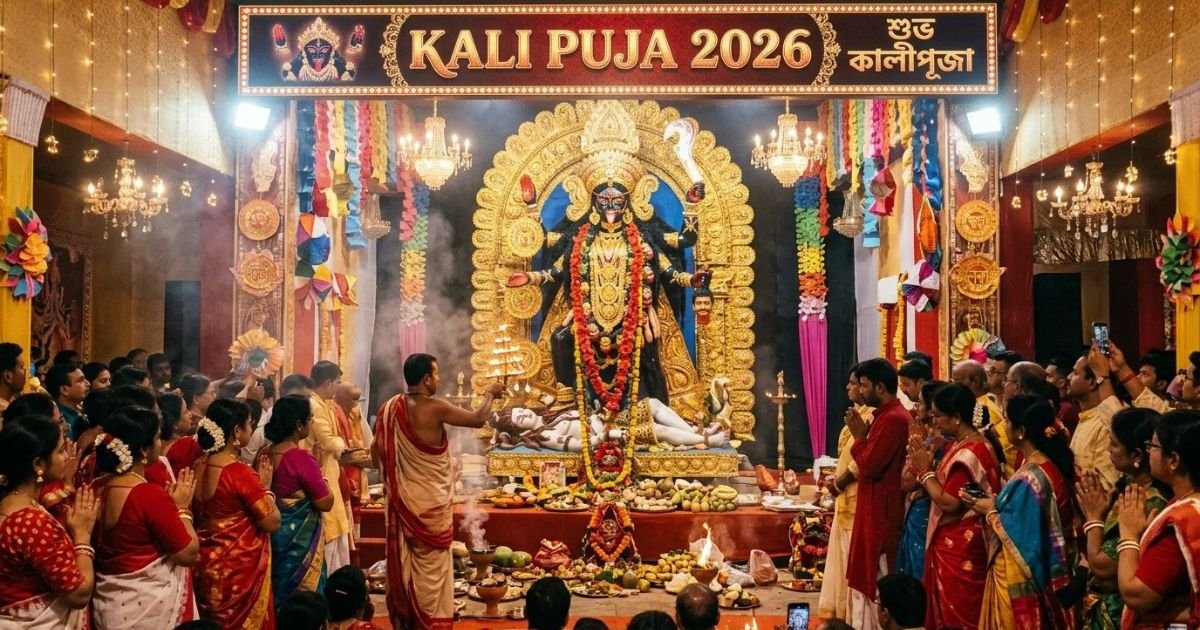

Kali Puja 2026 falls on Sunday, November 8, the same new moon night as Diwali. The main worship, called Nishita Puja, is performed close to midnight. Exact timings change from city to city, so it helps to check the details below before you plan your evening.
This guide covers the Kali Puja date, Amavasya timings, the Nishita muhurat, a simple puja vidhi, mantras, regional traditions, pandal tips and the questions people search most. Timings are based on Drik Panchang data published for 2026 and cross checked against other panchang sources. Where sources disagree, I say so.
Kali Puja 2026 Date and Time: Quick Answer
Kali Puja 2026 is on Sunday, November 8, 2026, on Kartik Amavasya in the Krishna Paksha.
- Amavasya tithi begins: 11:27 AM IST on November 8
- Amavasya tithi ends: 12:31 PM IST on November 9
- Nishita Puja muhurat (New Delhi): 11:39 PM on November 8 to 12:31 AM on November 9, about 53 minutes
- Nishita Puja muhurat (Kolkata): about 10:55 PM to 11:46 PM on November 8
- Kali Chaudas (Bhoot Chaturdashi): Saturday, November 7, 2026
- West Bengal: listed as a public holiday on November 8
Here is how the date moves from year to year. It shifts because Kali Puja follows the lunar calendar, not the Gregorian one.
| Year | Date | Day |
| 2025 | October 20 | Monday |
| 2026 | November 8 | Sunday |
| 2027 | October 28 or 29 (sources differ) | Thursday or Friday |
| 2028 | October 17 | Tuesday |
How Many Days Are Left for Kali Puja 2026?
As of today, November 7, 2026, only one day is left. The main puja begins tomorrow night.
If you are reading this on another date, count the days to November 8, 2026. For 2027, the next Kali Puja arrives in late October, so watch for the final panchang dates closer to the time.
Understanding the Kali Puja Muhurat 2026
Most pages say “midnight” and stop there. The muhurat is more specific than that.
Nishita Kaal is the middle muhurta of the night, measured from local sunset to the next sunrise. It lasts roughly one fifteenth of the night. In 2026 that works out to about 53 minutes. Because it depends on your local sunset and sunrise, the window moves with your longitude.
That is why Kolkata and New Delhi show different times. Kolkata is further east, so its midnight comes earlier. Delhi’s window runs from 11:39 PM to 12:31 AM, while Kolkata’s is listed from 10:55 PM to 11:46 PM.
Keep these practical points in mind:
- Check your own city. A local panchang or your family priest will give the most reliable time.
- Bengali panjika timings can differ. Many Bengali families follow their own panjika, so a small gap from North Indian calendars is normal.
- The puja can run past midnight. The Vedic day runs from sunrise to sunrise, so a puja after 12:00 AM still belongs to November 8.
- Diwali households: If your home also does Lakshmi Puja, do it in the evening Pradosh Kaal. In New Delhi that window is 5:31 PM to 8:08 PM. Then move to Kali Puja later in the night.
What Is Kali Puja? A Quick Overview
Kali Puja is the night worship of Goddess Kali on Kartik Amavasya. It is also called Shyama Puja, Dipanwita Kali Puja and Mahanisha Puja.
While much of India lights lamps for Lakshmi on this night, Bengal, Odisha, Assam and nearby regions worship Kali. In Bengal, Lakshmi Puja is observed earlier, on Kojagari Purnima. At Kalighat in Kolkata, Kali is even worshipped as Lakshmi on this day.
The festival grew into its present scale over time. It spread widely in Bengal during the eighteenth century, when wealthy landowners and patrons sponsored it. Its popularity rose again in the nineteenth century, partly through the influence of the Kali devotee Sri Ramakrishna.
Kali Puja 2026 Date in Different States
The date is the same everywhere: November 8, 2026. What changes is the local muhurat and the style of celebration.
Kali Puja 2026 in West Bengal
West Bengal is the heart of the festival. Kolkata, Barasat, Naihati and Barrackpore are known for large community pujas, and Kolkata’s Kumartuli artisans make many of the idols.
The day before, on Bhoot Chaturdashi, many Bengali families light 14 lamps and eat choddo shak (a dish of 14 leafy greens). Devotees also visit Kalighat, Dakshineswar and, further out, Tarapith through the festival period. Barasat is known for the biggest Kali Puja celebrations in the state.
Kali Puja 2026 in Bihar
In Bihar, Bhagalpur in the Anga region is the main centre. Munger, Katihar and Purnea also celebrate. Bhagalpur is known for hundreds of pandals, towering idols (one of the largest is about 32 feet tall) and carnival style immersion processions that can last many hours. Bihpur is known for carrying 22 foot idols on shoulders during visarjan.
Many homes in Bihar and the Mithila region combine Diwali customs with Kali worship on the same night.
Kali Puja in Assam and Odisha
In Assam, Kali Puja sits within a strong Shakta tradition. The Kamakhya Temple on Neelachal Hill in Guwahati is one of the most important Shakti shrines, and local folk customs blend with the Bengali style of worship.
In Odisha, Puri, Bhubaneswar and Balasore host celebrations that mix Shakta and Tantric elements with local art and temple culture. Detailed written records of these regional customs are limited, so ask a local priest or family elder for specifics.
Related Post: Varanasi to Ayodhya Distance, Best Route,Taxi Fare & One Day Trip Guide
Chaiti Kali Puja and Maghi Kali Puja: What’s the Difference?
The Kartik Amavasya puja is the major one. But Kali is also worshipped on other Amavasya nights in some temples and households.
- Chaiti Kali Puja: Observed on the Amavasya of Chaitra month, usually in March or April.
- Maghi Kali Puja: Observed on the Amavasya of Magha month, usually in January or February.
- Phalaharini Kali Puja: Observed on the Amavasya of Jyeshtha month. In 2026 it was held on May 16, including at Sri Ramakrishna Math in Chennai.
For 2026, the Chaiti and Maghi observances have already passed. The Kartik puja remains the festival most people mean when they say Kali Puja. Dates for the smaller observances are set by local panchang, so confirm them with your temple.
Significance of Kali Puja
Kali Puja is not only a festival of fear and fire. It carries layers of meaning.
- Light in the darkest night: The new moon is the darkest night of the month. Worship on this night is a reminder that divine power is present even when nothing is visible.
- Time itself: The name Kali is linked to “Kaal,” meaning time. She stands for the force that creates, ends and renews everything.
- Freedom from fear: Her fierce form pushes devotees to face fear and death, not avoid them.
- A Shakta high point: Amavasya night is considered especially powerful for Shakta and Tantric sadhana.
- Motherhood: For many Bengalis, Kali is “Ma,” a mother who is both strict and deeply loving.
Who Is Goddess Kali? Understanding the Deity
Kali is one of the most layered goddesses in Hinduism. She represents time, change, death and liberation.
Common features of her image:
- Dark skin: Often read as the infinite void from which everything arises.
- Four arms: One holds a sword, one a severed head, while the other two show blessing and protection.
- Garland of skulls: Often explained as the letters of the Sanskrit alphabet, standing for sound and knowledge.
- Tongue out: Explained in different ways, from shame at stepping on Shiva to the consuming of all creation.
- Standing on Shiva: A powerful image of energy (Shakti) meeting stillness (Shiva).
Kali has several forms. Dakshina Kali is the form most worshipped in Bengal homes and at Kalighat. Others include Bhadrakali, Shmashana Kali and Mahakali.
Kali’s Relationship with Durga and Shiva
In the Devi Mahatmya, Kali emerges from Durga’s brow during battle to destroy the demons Chanda and Munda. She later defeats Raktabija. Every drop of his blood that touched the ground created a new demon, so Kali drank it before it could fall.
In Tantric tradition, Kali is the first of the Dasa Mahavidyas, the ten wisdom goddesses.
Shiva is her consort. The well known image shows her stepping on his body in the middle of her rage. Realising it is him, she stops. That moment is why Shiva is seen as the one who calms her.
How to Perform Kali Puja 2026 Step by Step
This is a general home puja outline. Families follow different traditions (Vaishnava, Shakta, Tantric), so adapt it with guidance from your family priest.
Samagri (items to keep ready)
- Kali idol or image
- Red hibiscus (jaba) flowers
- Incense, ghee or oil lamps, and camphor
- Sindoor, sandalwood paste and rice grains
- Ganga water (or clean water), mango leaves and a coconut
- Fruits, sweets and the bhog dishes
- A clean cloth for the seat
Steps
- Clean the space. Clean the puja area and the home on the afternoon of Amavasya.
- Set up the idol. Place the Kali idol or picture on a clean, raised seat.
- Install the kalash. Fill a pot with water, add mango leaves and place a coconut on top.
- Take the sankalpa. State your intention and invoke the goddess, with a priest if possible.
- Offer the upachars. Offer a seat, water, bath, cloth, flowers, incense, lamp and food in sequence.
- Offer red hibiscus. Jaba flowers are the classic offering to Kali.
- Begin Nishita Puja. Perform the main worship within the muhurat for your city.
- Chant mantras. Repeat the Kali mantras with devotion and a steady mind.
- Offer the bhog and aarti. Serve the bhog, then perform aarti.
- Immerse the idol. Visarjan is done the next day or after the family’s customary time.
Rituals and Regional Traditions
- Nishita Puja: The main midnight worship, done in homes, pandals and temples.
- Clay idols: Artisans in Kumartuli and other centres prepare idols weeks in advance.
- Bhog: The classic offering is bhoger khichuri with labra (mixed vegetables), begun bhaja (fried brinjal), payesh and sometimes luchi. These dishes are cooked without onion and garlic.
- Two styles of worship: Some homes follow a mainstream Brahmanical style with offerings of rice, lentils, fruit and sweets. In Tantric tradition, animal sacrifice is practised at some sites. Many modern households use vegetarian substitutes such as pumpkin or sugarcane.
- Fireworks and lights: Bengali families light lamps and burst fireworks as part of the night.
Spiritual Benefits of Kali Puja
Devotees describe several benefits. These come from tradition and personal belief, not scientific claims.
- Courage: Facing Kali’s fierce form is said to build inner strength.
- Protection: She is worshipped as a guardian against harm and negativity.
- Letting go: The festival is often used as a moment to release old habits and attachments.
- Calm about change: Reflecting on Kali as time can help people accept impermanence.
Mantras and Sacred Chants for Kali Puja
Kali Moola Mantra
Om Krim Kalikayai Namah
This is the best known seed mantra of Kali, used for japa during the puja.
Kali Dhyana Verse (from the Devi Stotra)
Jayanti Mangala Kali Bhadrakali Kapalini Durga Kshama Shiva Dhatri Svaha Svadha Namostute
This verse salutes the goddess in her many names and forms, and is widely chanted during Devi worship.
Tips for chanting
- Sit in a clean place facing east or north.
Kali Puja Wishes and Greetings for 2026
Kali Puja greetings are usually warm and respectful. Here are a few you can send:
- “Shubho Kali Puja! May Maa Kali fill your home with courage and peace.”
- “On this dark new moon night, may the Mother light the way for you and your family.”
- “Wishing you strength, fearlessness and blessings this Shyama Puja.”
- “Shubho Kali Pujo to you and your loved ones. Joy Ma Kali!”
Kali Puja Pandal Culture: What to Expect
Pandals are where the festival becomes a street celebration. Community clubs spend months on themes, lighting and idol design. Crowds usually build after sunset and peak around midnight. Many pandals remain open until dawn.
Popular pandal areas often named in Kolkata guides include Girish Park, Shibpur and Barasat. Temples such as Kalighat and Dakshineswar draw huge crowds through the night.
Practical tips
- Go early. Evening is calmer than the midnight rush.
- Plan transport. Roads close or divert near big pandals, and festival nights are busy.
- Travel light. Keep valuables minimal and stay with your group.
- Follow local rules. Respect temple guidelines and crowd control instructions.
Frequently Asked Questions About Kali Puja 2026
When is Kali Puja 2026?
Kali Puja 2026 is on Sunday, November 8, 2026, on Kartik Amavasya.
What is the Kali Puja 2026 time?
The Nishita muhurat is 11:39 PM to 12:31 AM in New Delhi and about 10:55 PM to 11:46 PM in Kolkata.
When does Amavasya start and end in 2026?
Amavasya begins at 11:27 AM on November 8 and ends at 12:31 PM on November 9, IST.
Why is Kali Puja celebrated on Diwali night?
Both occur on Kartik Amavasya. Eastern India worships Kali while most other regions worship Lakshmi.
What is Shyama Puja?
Shyama Puja is another name for Kali Puja. Shyama means “dark one.”
What is Bhoot Chaturdashi?
It is the day before Kali Puja, when Bengali families light 14 lamps and eat 14 leafy greens. In 2026 it is November 7.
Why is Kali Puja performed at midnight?
Nishita Kaal, the midpoint of the night, is considered the most powerful time for Kali worship.
Can I perform Kali Puja at home?
Yes. A simple home puja with flowers, lamps, bhog and mantras is common, ideally guided by a priest.
Which temples are famous for Kali Puja?
Kalighat and Dakshineswar in Kolkata are the best known, along with Tarapith in Birbhum.
How is Kali Puja different from Durga Puja?
Durga Puja runs for several days, while Kali Puja is centred on one night of midnight worship.
What is Chaiti Kali Puja?
It is an Amavasya observance in Chaitra month, usually March or April, kept by some temples and devotees.
Conclusion
Kali Puja 2026 arrives on Sunday, November 8, with the Nishita muhurat falling late that night. Check the time for your own city, keep your samagri ready and begin early so you are not rushed.
The festival is more than a ritual. It asks you to face fear, accept change and see the goddess as both fierce protector and loving mother. Whether you worship at home, visit Kalighat or simply walk through a pandal, the heart of the night is the same: devotion, courage and light in the dark.

Wei Zhang is the admin of Magazinereflex.com, a travel-focused website dedicated to exploring destinations, sharing travel tips, and inspiring memorable adventures. With a passion for discovering new places and learning about different cultures, Wei Zhang aims to provide readers with helpful travel guides, destination insights, and practical advice to make their journeys more enjoyable. His goal is to inspire travelers to explore the world with confidence and curiosity.
