
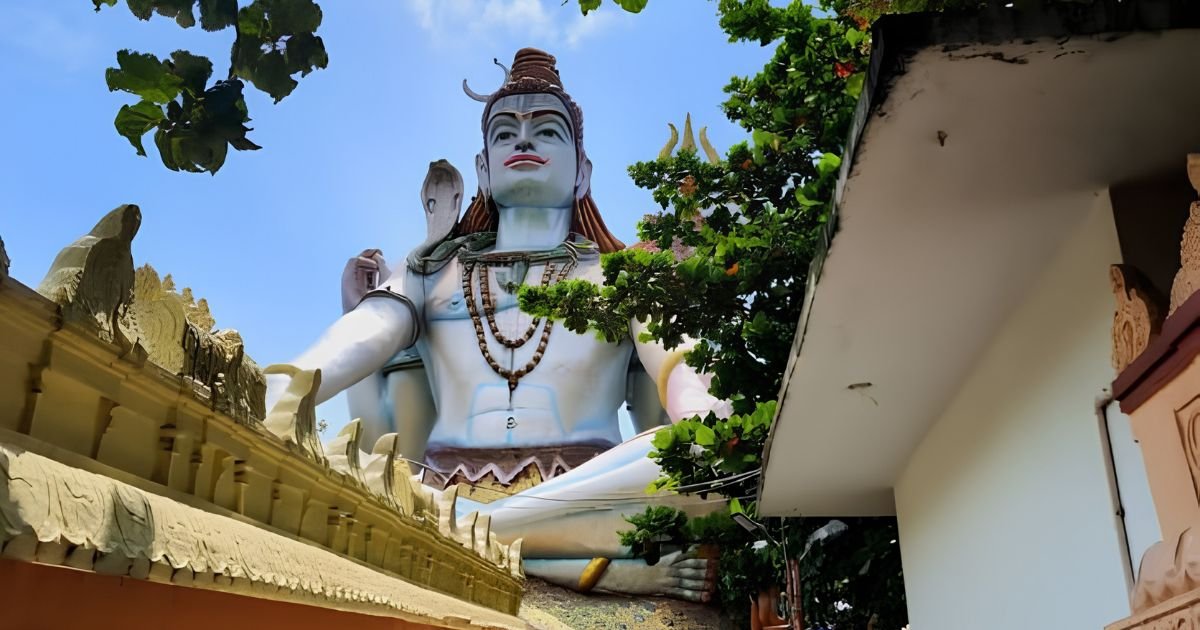

Imagine wading through ankle-deep water to reach all twelve Jyotirlingas in a single visit. That’s the everyday reality at Bhukailash Temple Tandur in Telangana. Officially called Bhukailash Dwadasha Devasthanam, this Shiva shrine sits about 110 to 130 km from Hyderabad. It works as an easy weekend pilgrimage and a quiet day trip. This guide covers history, timings, ticket price, festivals and routes so you can plan with confidence.
Quick Facts at a Glance
| Detail | Information |
| Official name | Bhukailash Dwadasha Devasthanam |
| Also known as | Water Theme Temple |
| Deity | Lord Shiva |
| Address | Antharam Thanda, Tandur, Vikarabad district, Telangana 501141 |
| Opened | 2010 |
| Main landmark | 65-foot Shiva statue |
| Signature experience | Water-path darshan of 12 Jyotirlinga replicas |
| Entry fee | About Rs. 100 per person (confirm on arrival) |
| Distance from Hyderabad | Roughly 110 to 130 km |
Introduction to Bhukailash: Meaning and Spiritual Concept
The name tells the whole story. “Bhu” means Earth. “Kailash” points to Mount Kailash, the Himalayan home of Lord Shiva. Put together, Bhukailash means “Kailash on Earth.”
The idea has deep roots in Hindu practice. Not everyone can trek to Kailash. So devotees have long built temples that carry its spirit into everyday life. The Tandur temple follows that tradition and adds a twist. It uses water as part of the worship, so the walk itself becomes the ritual.
Bhukailash Temple Tandur Location
The temple stands at Antharam Thanda on the Tandur to Mominpet road. It falls under Vikarabad district, and the PIN code is 501141. Some older pages still place it in Rangareddy district, so ignore that label.
Distance from Tandur town varies by source. Some listings say about 2 km. Others say about 5 km. Plan for a short 15 to 20 minute ride by auto-rickshaw from Tandur bus stand. Tandur itself is a stone and red gram trading town, so you’ll pass a working local economy on the way.
Bhukailash Temple Tandur History
Every great temple starts with one person’s promise. Here, it was Pawar Vasu Naik, a Shiva devotee from Antharam Thanda.
- 2001: He visited the Pashupatinath Temple in Nepal.
- Following years: He stayed on for a long stretch, serving and worshipping there.
- The vision: He wanted to give his home region a temple with that same spiritual feel.
- Construction: Work ran for about nine years.
- 2010: The temple opened to devotees.
OurTemples confirms the Pashupatinath inspiration, the nine-year build and the 2010 opening. Reports also say the family put a large share of its business income into the project, backed by devotee donations. Treat the exact percentage as local lore rather than an audited figure.
Mythological Significance of Bhukailash
In Hindu belief, Mount Kailash is far more than a mountain. It’s Shiva’s cosmic seat, where he meditates with Parvati. Many traditions call it the axis between the earthly and divine worlds.
The Jyotirlingas add another layer. Jyoti means light, and each Jyotirlinga is a radiant sign of Shiva. Traditional lists name twelve, spread across India:
- Somnath (Gujarat)
- Mallikarjuna (Srisailam, Andhra Pradesh)
- Mahakaleshwar (Ujjain)
- Omkareshwar (Madhya Pradesh)
- Kedarnath (Uttarakhand)
- Bhimashankar (Maharashtra)
- Kashi Vishwanath (Varanasi)
- Trimbakeshwar (Maharashtra)
- Vaidyanath (listed in different places by different traditions)
- Nageshwar (Gujarat)
- Rameshwaram (Tamil Nadu)
- Grishneshwar (Maharashtra)
You can read more on the Jyotirlinga overview on Wikipedia. Visiting all twelve normally takes months. At Tandur, replicas of all twelve sit in one complex. Many pilgrims see that as a meaningful shortcut. Others treat it as a gateway that inspires the longer journey.
Architecture and Temple Layout
The design mixes Pashupatinath-style inspiration with local South Indian temple elements. Here’s what stands out:
- 65-foot Shiva statue: You can spot it from a distance. According to HinduPad, the main lingam sits beneath this statue.
- 35-foot Hanuman statue: A tall guardian figure within the grounds.
- Underground Jyotirlinga chamber: The twelve replicas sit in a water-filled space.
- Subsidiary shrines: These include Veerabhadra, Kalabhairava, Ganesha, Ayyappa, Radha Krishna, Dattatreya, Venkateshwara, Raghavendra Swamy, Sai Baba and Kalika Devi.
- Grounds and amenities: Green courtyards, a pond, a function hall and pilgrim rooms.
The layout suits families. You can see the main sights in one loop without long walks.
Daily Rituals and Worship
Daily worship follows the Shaiva tradition. Priests usually perform morning, midday and evening rituals. These commonly include:
- Abhishekam, the ritual bathing of the lingam
- Alankaram, the decoration of the deity
- Naivedyam, the food offering
- Deeparadhana, the lamp offering
The centerpiece for visitors is the water-path darshan. You remove your footwear, step into shallow water and walk past the Jyotirlinga replicas. Then you reach the main sanctum. Devotees describe it as slow, quiet and grounding. Because ritual schedules can change, ask the staff at the gate about that day’s pujas.
Bhukailash Temple Tandur Ticket Price
Yes, this temple charges an entry fee. Recent listings, including TempleSocial, put it at Rs. 100 to 101 per person. Small children are usually free, though that’s not guaranteed.
Not everyone likes paying to enter a place of worship. Justdial reviews include visitors who felt the fee was unnecessary. Others see it as upkeep for a large, well-kept complex. Carry small cash notes and confirm the price at the counter. Festival days may differ.
Major Festivals Celebrated
Festival days change the mood completely. Crowds grow and the grounds fill with lamps and chanting. If you dislike crowds, choose a regular weekday instead.
Maha Shivaratri Brahmotsavam
This is the biggest event of the year. OurTemples describes week-long Brahmotsavams with rituals such as Shiva-Parvati Kalyanam, homas and elaborate abhishekams. Night-long vigils are central.
Maha Shivaratri falls on 6 March 2027, according to Drik Panchang. The date shifts every year, so check the temple’s announcements closer to the day.
Shravan Maas (Holy Month of Lord Shiva)
Shravan usually falls in July and August. Mondays are especially popular for Shiva worship. Expect longer queues on those days.
Pradosha Vrat
Pradosha is observed twice a month on Trayodashi, the 13th lunar day. It’s an evening observance for Shiva devotees. Plan an evening visit if you want to join it.
Kartika Masam
Kartika typically runs from late October into November. It’s linked with lamp lighting and extra prayers at Shiva temples across the Telugu states. The cool weather makes it a comfortable month to visit.
Related post:Vemulawada Rajarajeshwara Swamy Temple History, Significance, Timings & Complete Expert Guide
Spiritual Benefits of Worship
Faith shapes what people take from this place. Devotees commonly say:
- Seeing all twelve Jyotirlinga replicas in one visit brings great merit.
- Vows made here, called mokku locally, are fulfilled.
- The water walk calms the mind.
- The quiet grounds ease stress.
These are beliefs and personal experiences, not measurable outcomes. Still, the calm setting and slow pace help many visitors feel lighter. Some people simply come for the peace.
Bhukailash Temple Tandur Timings
Most current listings show two darshan windows:
| Session | Timing |
| Morning | 6:00 AM to 12:00 PM |
| Evening | 4:30 PM to 8:00 PM |
An older visitor comment on HinduPad mentions 9 AM to 7 PM. That shows how timings can change. Confirm with the temple office before you travel. Festival days often run longer. There’s no advance booking system for general darshan. You simply arrive in person, according to visitor replies on HinduPad.
Tip: Reach by 6:30 AM for the calmest water-path darshan.
How to Reach Bhukailash Temple Tandur
The temple is well connected. Choose the mode that fits your budget and time.
By Road
From Hyderabad, follow the Chevella, Vikarabad and Tandur route. Allow around 2.5 hours in normal traffic. TGSRTC buses run from MGBS and JBS to Tandur bus stand, and OurTemples says an auto from there takes about 15 minutes. Driving gives you the most flexibility.
By Train
Tandur Railway Station (TDU) sits on the Secunderabad to Wadi line. Several daily trains stop there, so check IRCTC for current schedules. From the station, take a local auto or taxi to Antharam Thanda.
By Air
Rajiv Gandhi International Airport in Hyderabad is the nearest major airport. It’s roughly 110 to 130 km away. Most visitors take a prepaid cab or head to Secunderabad for a train.
A Simple One-Day Plan from Hyderabad
- Leave Hyderabad by 5:00 AM.
- Reach the temple around 7:30 AM and buy tickets.
- Complete the water-path darshan and main sanctum visit.
- Explore the grounds and shrines.
- Visit a nearby temple, then eat lunch in Tandur.
- Start back by mid-afternoon to avoid evening traffic.
Best Time to Visit
Timing changes the experience a lot.
- October to February: Cool, dry and pleasant. This is the best window.
- Maha Shivaratri: Best for festival energy, but expect big crowds.
- Early mornings: Quieter darshan any day of the year.
- April to June: Very hot. Skip it if you can.
- Monsoon: The greenery looks lovely, but roads can slow you down.
Temple Etiquette
A few simple habits keep the visit smooth:
- Dress modestly. Choose covered shoulders and knees.
- Remove footwear before entering the temple premises.
- Keep your voice low near the water channel.
- Ask staff before taking photos in the sanctum area.
- Avoid leather items near the shrine.
- Keep the premises free of non-vegetarian food and alcohol.
- Wait patiently in queues, especially on festival days.
- Wear clothes that can get a little wet near the ankles.
Nearby Attractions
You can pair the temple with a few short stops:
- Panchamukhi Hanuman Temple: A shrine to the five-faced form of Hanuman.
- Kalika Devi Temple: Known for its powerful, protective feel.
- Kothlapur Yellamma Temple: A well-known local goddess shrine.
- Bugga Rameshwaram Temple: A Shiva temple in the Vikarabad area.
- Tandur town: Local food stalls and a market shaped by the region’s stone and pulse trade.
Distances vary, so ask your driver before you plan the order.
Devotee Experiences
Visitors tend to mention the same few things. Many talk about the quiet after they enter the gate. Others say the water walk feels unlike a standard darshan queue. Families like the open, green courtyards. Some visitors mention the entry fee as a downside.
A balanced view helps. The temple feels calm and well kept to most people. A few see the ticket cost as out of step with a place of worship. Read recent reviews close to your travel date for current impressions.
Cultural Importance
Bhukailash Temple shows how one person’s devotion can grow into a regional landmark. It carries forward Shaiva traditions and hosts large gatherings during festivals. It also supports local livelihoods. Vendors, drivers and small hospitality businesses around Tandur benefit from the steady flow of pilgrims.
The temple also gives Hyderabad-area families a reachable pilgrimage. Many people who can’t travel far for a Jyotirlinga darshan find this a meaningful alternative.
Why Bhukailash Temple is Unique
Plenty of Shiva temples exist across India. This one stands out for these reasons:
- Water-theme design: You walk through water to reach the deity.
- Twelve Jyotirlinga replicas together: One location instead of a nationwide journey.
- 65-foot Shiva statue: A clear landmark for the whole area.
- Pashupatinath inspiration: A direct link to a famous Nepali shrine.
- Devotion-led origin: It grew from a private vision and public donations.
- Multi-shrine complex: Many deities within a single campus.
Frequently Asked Questions
Where is Bhukailash Temple located?
It’s at Antharam Thanda near Tandur in Vikarabad district, Telangana (PIN 501141).
What is the entry fee for Bhukailash Temple Tandur?
The fee is about Rs. 100 per person. Confirm at the counter, since festival pricing can differ.
What are Bhukailash Temple Tandur timings?
Current listings show 6 AM to 12 PM and 4:30 PM to 8 PM. Check locally before you go.
How far is Bhukailash Temple from Hyderabad?
It’s roughly 110 to 130 km, depending on your route. Most drives take around 2.5 hours.
Who built Bhukailash Temple Tandur?
Pawar Vasu Naik built it with his family and devotee support. It opened in 2010 after about nine years of work.
Why is it called Bhukailash?
The name means “Kailash on Earth,” linking the temple to Shiva’s Himalayan abode.
What is the best time to visit Bhukailash Temple?
October to February offers the best weather. Choose Maha Shivaratri if you want the biggest festival atmosphere.
Is Bhukailash Temple in Tandur the same as Bhukailash Temple in Kolkata?
No. The Kolkata temple is a pair of Shiva shrines built in 1781, according to West Bengal Tourism content. The Tandur temple is a modern complex that opened in 2010.
Conclusion
Bhukailash Temple Tandur offers something rare. You get a peaceful Shiva darshan, a distinctive water-path walk and replicas of all twelve Jyotirlingas in one compound. It’s close enough to Hyderabad for a single-day trip and rich enough to deserve a slow visit.
Plan for October to February, arrive early and confirm the fee and timings before you leave. Bring modest clothing and a little patience on festival days. If you want a Shiva pilgrimage that feels both grand and calm, this is a strong choice.

Wei Zhang is the admin of Magazinereflex.com, a travel-focused website dedicated to exploring destinations, sharing travel tips, and inspiring memorable adventures. With a passion for discovering new places and learning about different cultures, Wei Zhang aims to provide readers with helpful travel guides, destination insights, and practical advice to make their journeys more enjoyable. His goal is to inspire travelers to explore the world with confidence and curiosity.
